Message from Head of the HR Division
Through the global engagement survey, we listen to employees and work continuously to improve human resource-related measures.
Basic Approach
The industrial gases business forms a critical part of the industry's infrastructure, while the Thermos business provides lifestyle products used daily by people around the world. Integrity is the cornerstone of our human resources, supporting the Group's corporate activities in areas such as respect for human rights, safety and security, and corporate ethics. Without integrity, we cannot earn the trust of our stakeholders, including customers and investors.
In FYE2024, we were able to compare our global engagement survey results with the previous year for the first time, and we found that the entire Group had made collective improvements. This progress is undoubtedly due to various factors; however, I believe that one key driver was employees engaging with integrity in their respective roles, influencing one another positively, and demonstrating excellent teamwork.
Our organizational culture is designed to ensure that we fulfill our social responsibilities as a company, in line with the Group's Code of Conduct. By fostering employee engagement through a shared commitment to the Group's Philosophy and Vision, I believe the Group can make an even greater contribution to society.
Talent Development Strategy for Continuous Growth
The Group, comprising Nippon Sanso Holdings and its operating companies, operates with a focus on on-site production and consumption of industrial gas products, which emphasizes the autonomy of its operating companies. This same approach is applied to our talent strategy, recognizing that people are our most valuable management resource. While this autonomy enhances the activity of the operating companies, the Group also shares and addresses human resource challenges collectively to align with the broader management strategies that require engagement across the entire Group.
In promoting diversity, securing and developing talent with diverse knowledge, experience, and perspectives is crucial for global growth in the rapidly changing business environment. The mediumterm management plan (MTP), NS Vision 2026, particularly emphasizes the active participation of women. In Japan, where progress in this area has been slower, we launched specific initiatives in April to strengthen our organization and personnel, rolling out these initiatives rapidly. Although progress toward achieving the FYE2026 numerical targets has been slower in some regions due to organizational reforms and other factors, we are working to embed individual talent strategies across each region during the MTP period.
Regarding employee engagement, as mentioned earlier, the Group's overall participation rate and scores have improved. However, it is crucial for management to analyze these results, propose measures to enhance the work environment, and implement them in collaboration with the relevant stakeholders. Responses to questions about diversity, in particular, provide valuable insights for future policy proposals, and employee feedback should be incorporated into our initiatives to drive continuous improvement.
Another critical focus is on securing and developing global talents. The opportunities of the electronics business and the carbon neutral field are expected to grow more, while IT security and other areas face increasing threats each year. The entire Group must engage in global talent exchanges and collaboration to seize opportunities and address these challenges effectively.
Additionally, the continued global promotion of Operational Excellence, which involves sharing successful measures and advanced case studies to boost productivity, will have a significant impact. The NSHD holding company functions, which understand and coordinate with each operating company's specific areas, businesses, and human resources, are well-positioned to develop and execute more effective strategies for the entire Group. These functions are carried out by human resources with the desire and capability to act globally, and we will focus on securing and developing such talent, particularly in Japan, including NSHD, where progress has been somewhat slower.
The Group boasts exceptional talent worldwide. We will work closely with our operating companies to create an environment where all employees can deeply commit to the Company's Vision and Mission and fulfill their duties toward achieving the MTP. This will enable them to grow personally, contribute to society and the planet, and take pride in their roles as "The Gas Professionals" or Thermos professionals.
(This content is current as of September 2025.)
Yasukazu Takada
General Manager of Human Resources
Nippon Sanso Holdings Corporation
The Nippon Sanso Holdings Group’s Human Resource Strategy
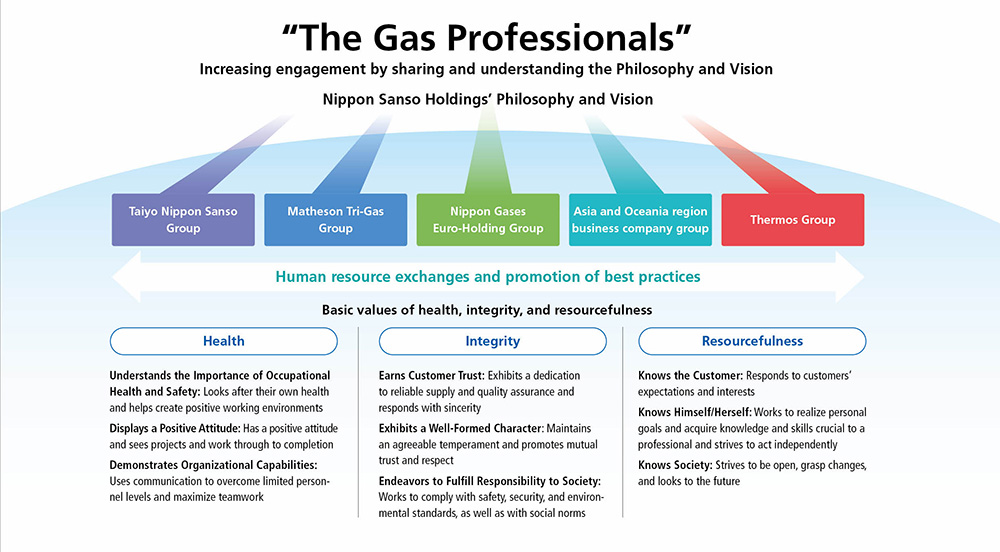
The Nippon Sanso Holdings Group Philosophy has the tagline “The Gas Professionals.” To nurture such professionals
with a sense of mission and a desire to contribute to society and the world, it is important to focus on the qualities
of health, integrity, and resourcefulness. These values have been inherited by us from the time of its
predecessor, the former Taiyo Nippon Sanso Corporation. Each operating company will focus on these essential
qualities, making reference to its own unique values as well and modifying them into a concept that is easy to
understand. Since health, integrity, and resourcefulness are shared by all Group companies, including Thermos, which
operates globally, employees say that they find them easy to understand.
(The above figure reflects the content as of September 2025.)
Strategy for Improving Employee Engagement
Our group is making a focused effort to improve employee engagement by sharing and understanding the Group
Philosophy and Group Vision. As a group that operates globally, we have taken measures to advance employee engagement
such as promoting human resource exchange programs, diversity and inclusion, and improving our personnel systems.
From the perspective of diversity and inclusion, from FYE2023, we have set “rate of female employees” and “rate of
female management posts” as non-financial KPIs for the first time. We will not only strive to expand
opportunities for participation by female employees but also to create an organization and systems befitting a global
company. In addition, with regard to improving employee engagement, we are currently conducting a global employee
engagement survey, the results of which will be reflected in our human resource strategies going forward.
Initiative to Sustainable Supply Chain
Basic Approach and Policy
We are addressing the resolution of environmental and social issues based on its philosophy
“Proactive. Innovative. Collaborative. Making life better through gas technology.” We believe resolving these problems and realizing a sustainable society requires joint efforts with wide range of suppliers, and established the procurement policy. We will comply with this policy and contribute to realization of a sustainable society.
Procurement Policy
Engagement with suppliers
Initiative to Share the “Procurement Guidelines”
Through sharing the “Procurement Guidelines,” we require both new and existing suppliers to comply with environmental matters (such as reduction of greenhouse gas and preservation of water resources), human rights, and occupational health and safety. Based on the RBA※ Code of Conduct, we also assess suppliers’ responses and compliance regarding the environment, human rights, and occupational health and safety in order to select business partners.
*Responsible Business Alliance: An organization of major companies working to improve society, the environment, and ethics in global supply chains
Procurement Guidelines
New Suppliers
For all suppliers with whom we initiate new business relationships, we request either an evaluation using a questionnaire based on the RBA Code of Conduct or the signing of an agreement to the "Procurement Guidelines."
Existing Suppliers
For business partners with a certain level of track record, we conduct evaluations using a questionnaire based on the RBA Code of Conduct.
Initiative to Human Rights
Basic Approach and Policy
We support protection of internationally proclaimed human rights, are aware of corporate responsibilities to respect human rights, and respect dignity and rights of all people. We never make discrimination or give unfair treatment for any reason whatsoever such as race, nationality, ethnic group, sex, religion, creed, disability, health condition, economic background, political opinion, personal preference, sexual diversity, social status, family origin, or other positions. Our group not only endeavor to provide human rights education to our employees, but also asks all our stakeholders to approve, understand, and put into practice our group's policies.
Global Policy on Respecting Human Rights, Contributing to Society, Employment, Labor and Health
Structure and System
We position respect for human rights as one of the preconditions for our company's existence within our materiality and promote initiatives to address it.
We have established a company-wide risk management framework centered on the “Global Risk Management Committee,” chaired by the President CEO, clarifying roles and responsibilities across the group, assessing management risks, and optimizing risk management activities. The President CEO has ultimate responsibility for the preparation and implementation of the risk management structure covering all Group companies. Furthermore, the presidents of the operating companies are in charge of risk management in their respective regions and have responsibility for the preparation and implementation of their respective regional risk management structures. They oversee persons in charge of promoting regional risk management, who promote risk management in each region. Risks related to human rights are also reported to the Global Risk Management Committee, and are also reported to the Board of Directors.
For details of the risk management framework, please refer to this page.
Remediation
If it becomes clear that our group's business activities have caused, or contributed to, an adverse impact on human rights, we will work to remedy the situation through fair and legitimate processes.
Human Rights Education
We provide awareness-raising on the relationship between corporate activities and human rights as part of our in-house training.
Since 2016, we have included human rights issues such as sexual harassment and power harassment in e-learning and other training for employees every year. We conduct education and awareness activities—such as training on how to respond when harassment actually occurs or when reports are received, and publicizing reporting channels—to ensure thorough understanding of human rights and to foster an environment that does not tolerate harassment on a day-to-day basis. We also provide training on our code of conduct that includes human rights-related items.
Human Rights Due Diligence
We have established a human rights due diligence system in accordance with the procedures outlined in the United Nations' Guiding Principles on Business and Human Rights, and we will assess a wide range of human rights issues — including the five ILO core labour standards set out in the ILO Declaration on Fundamental Principles and Rights at Work (freedom of association and collective bargaining, forced labour, child labour, discrimination, and occupational health and safety) — and disclose progress on them.
Through this initiative, we will conduct ongoing due diligence, continuously deepen our understanding of salient human rights issues within our business and supply chain, and remain committed to stakeholder engagement activities.
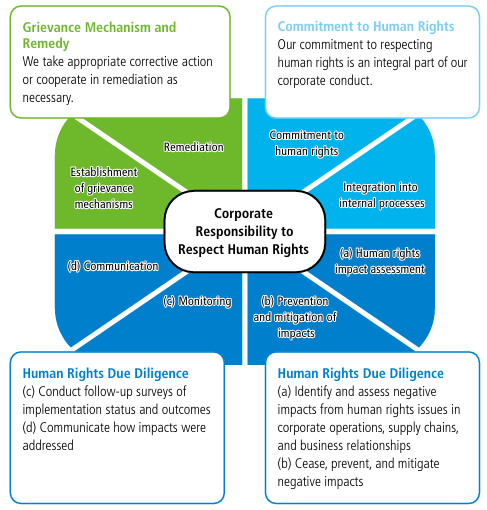
Progress on Our Human Rights Due Diligence
・We have launched a human rights due diligence project to identify "salient human rights issues" in our business operations.
・We are organizing our company’s business value chain and stakeholders with the help of external experts, and conducting research on human rights issues related to our company.
・Based on the ideas recommended in the OECD Guidance and the UN Guiding Principles reporting framework, we are assessing the severity and likelihood of occurrence for each human rights issue.
Key issues related to social systems
- Safety and Security
- Product and service safety and quality
- Respect for Human Rights
- Sustainable supply chain
- Diversity and inclusion
- Development and maintenance of human resources
- Employee and family health
- Improvement of employee engagement
- Contribution to regional and industrial development as social infrastructure
- Provision of comfortable and prosperous lifestyles
- Coexistence with local communities
- Improvement of productivity and promotion of production optimization
- Technology and R&D capabilities that support the creation of customer value and social value
- Pursuit of customer satisfaction
- Promotion of initiatives for digital innovation
- Protection and effective utilization of intellectual property
Associated non-financial program
This content is based on the Medium‑Term Management Plan through the fiscal year ending March 2026. For initiatives from the fiscal year ending March 2027 onward, please refer to the
Medium‑term Management Plan page.
Sustainability Data
Sustainability Topics
Policies